Best Walking Tour in Kotor
Kotor Walking Tour Continues: Off to the St. Tryphon’s Square
As our Kotor Walking Tour continues, we slowly delve into city’s cultural epicenter. We depart from the Main Square and into the quiet, storied nooks of St. Tryphon Square and the surrounding palazzos. Walking through the alleys that have been inhabited for centuries, we will learn about the stories of aristocratic families, Gothic and Baroque buildings, and lingering reminders of Kotor’s historical past.
The Bizanti Palace: The Venetian Era’s Legacy
The Bizanti Palace, a historic Palazzo that speaks to the illustrious history of the Bizanti family, dating back to the 11th century, is where we will start this leg of our walking tour. From this family came captains, scholars, priests, judges, and one famous member, Nikola Bizanti. This magnificent palace was overseen by Nikola throughout the reconstruction after the disastrous earthquake of 1667, and it stands as a testament to the family’s tenacity and commitment to Kotor’s recovery.
Hidden in the tranquil courtyard of the Bizanti Palace lies beautifully well, one of the few remaining symbols of the family’s lost grandeur. A quiet relic that whispers of wealth and secrets long buried beneath Kotor’s ancient stones.
Opposite the Bizanti Palace stands the Beskuća Palace, built in 1776. The Beskuća family, though not as ancient as the Bizantis, rose to prominence in the late 18th century, accumulating estates around the Bay of Kotor. Legend has it that Joza Beskuća, determined to change the family name from Beskuća (“No houses”) to Stokuća (“100 houses”), built 99 homes before passing away, leaving his dream incomplete. Yet, his legacy endures in the grand residences he left behind.
Kotor’s Flour Square
Flour Square is dominated by the elegant Pima Palace, a 17th-century Renaissance-Baroque masterpiece. Despite enduring earthquakes, its ornate balconies, green shutters, and the Pima family coat of arms remain striking. Today, the palace hosts the Gallery of Solidarity (Galerija Solidarnosti).
Buća Palace: A Fusion of Styles
Just opposite, the Buća Palace, dating to the 14th century, blends Gothic and Baroque elements. Renovated after the 1667 earthquake, it bears the coats of arms of both the Buća and Pasquali families, illustrating Kotor’s rich and layered history.
St. Tryphon Square: The Beating Heart of Kotor
As our walking tour of Kotor goes deeper into the Old Town, we arrive at St. Tryphon Square, the vibrant heart of Kotor. This square is not only the epicenter of the city’s cultural life but also home to some of its most important institutions. Here, you’ll find the Municipal Hall, Historical Archive, and the Institute for the Protection of Cultural Monuments, each housed in remarkable buildings that line the square.
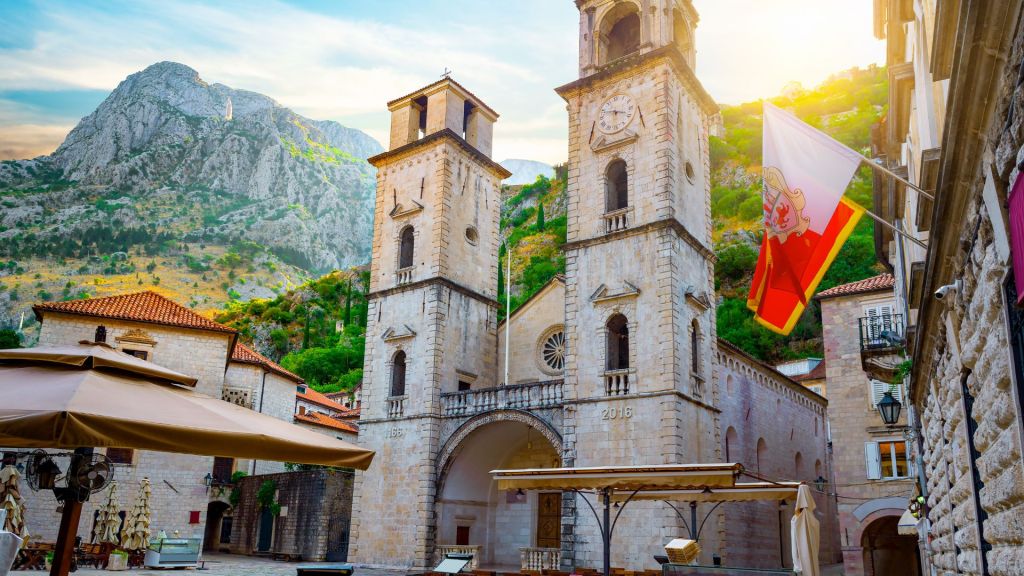
Dominating the space, however, is the magnificent St. Tryphon Cathedral, consecrated in 1166 and built on the site of a 9th-century temple. The cathedral’s two asymmetrical bell towers, a result of incomplete post-earthquake restoration, are a testament to Kotor’s turbulent history. Inside, you’ll find relics of St. Tryphon, Kotor’s patron saint, who was known for his miraculous healing abilities and whose remains were brought to the city in 809.
St. Tryphon Square is also the setting for many of Kotor’s most important cultural and religious celebrations, including the Feast of St. Tryphon, which features the traditional Kolo dance performed by the Boka Navy in their distinctive uniforms. If you’re lucky enough to be in Kotor during one of these events, you’ll experience firsthand the deep sense of tradition that permeates the city’s stone walls.
Conclusion to the Part Two of our Kotor Walking Tour
As we wrap up Part Two of our Kotor walking tour, take a moment to appreciate Kotor’s rich history, stunning architecture, and vibrant culture. We’ve explored centuries of faith, power, and artistry, yet there’s much more to uncover. Finally, we’ll dive deeper into Kotor’s maritime heritage and impressive fortifications.
Thank you for joining me through Kotor’s narrow streets and grand squares. Keep your camera ready and your curiosity alive for Part Three!
Want to explore Kotor further? Take our Kotor walking tour and discover even more of this incredible town.
 Kotor Walking Tour
Leave a comment